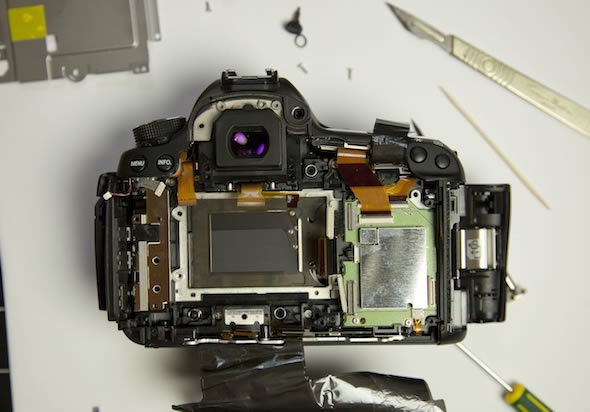
Camera makers load their goods with moiré-busting anti-aliasing (AA) filters, however these low-pass filters come with a big caveat. You see they are placed in front of the camera’s sensor and work by slightly blurring the image in order to avoid moiré and aliasing effects at the cost of resolution and sharpness.
It seems that Canon has chosen a pretty strong AA for its latest full-frame shooter, the 5D Mark III, which is bad news for videographers and lovers of sharp stills. Nikon offers two versions of the competing D800, the D800E flavor has a weaker anti-aliasing filter than the standard model, but Canon fans are pretty much stuck.
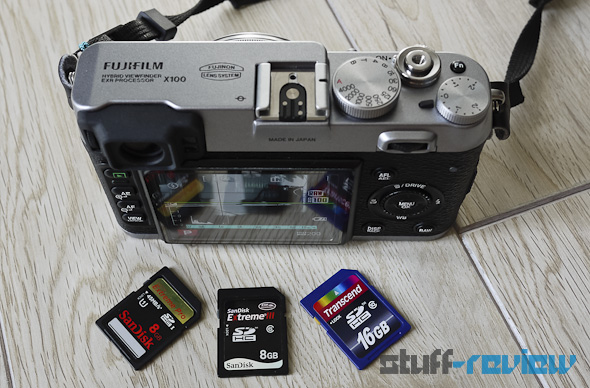
Now you’d think that a weak low-pass filter leaves you at the mercy of moiré, but in reality these patterns are not as common as they are made to be and we’ve seen the benefits to resolution of a weak anti-aliasing filter in our real world review of the Fujifilm X100 here.
continue reading
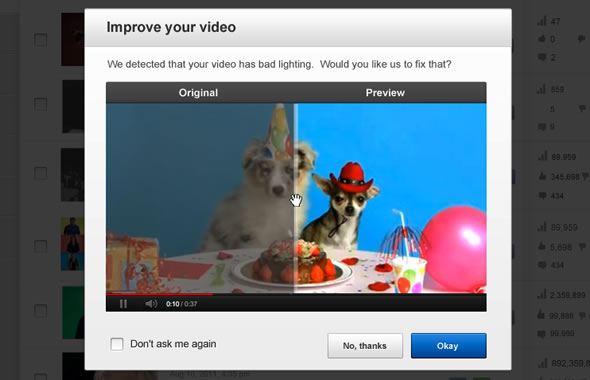

When Google bought a lesser-known digital video technology company called Green Parrot Pictures last year we were promised that some awesome automatic video enhancement technology would be coming to YouTube. It seems Google has been working hard in implementing this image processing technology on YouTube and today we get a look at the first set of improvements.
continue reading

Night street scenes, candlelight, partly lit faces, a fast moving bike, automobile headlights coming straight into your lens, these are tough scenes to shoot with any camera. Nikon has a point to make, and that is that its new D800 full-frame DSLR can shoot awesome HD video.
Just after the announcement of the Nikon D800, the company has posted a short movie titled “Joy Ride”, shot entirely with the new camera, demonstrating its video capabilities. You can watch the 4 minute extreme shooting challenge clip directed by Sandro below, as well as a behind the scenes video. We’re sure that anyone with a stash of good Nikon glass should be pretty giddy right now.
continue reading

The iPad has already demonstrated that it does indeed have the chops for some serious content creation. While a touch interface may not be suited for some tasks, it’s perfect for others, and video editing would be one of them. Avid, a name synonymous with prosumer video and audio production, has just released an iPad version of its Avid Studio application, which will now go head-to-head against Apple’s own iMovie.
continue reading

We’ve already covered how the Panasonic GH2 had been unlocked, using a custom firmware, and could now record video at an amazing 176Mbps. The latest version of the hack now removes the ISO 3,200 limit when recording video, so that you can push the camera to record up to ISO 12,800. Now, one would think that video at such high ISO would be rife with noise and completely unusable.
Well, it turns out that, although noise is there, it’s not as bad, and the hack allows the GH2 to become an amazing low-light shooter. This is especially true when shooting video in B&W where the noise just looks like film grain. It’s pretty mind-blowing that you can shoot such video with a sub-$1000 digital camera. You can find details on how to apply the firmware in by following this link.
Two videos showing off the GH2′s high-ISO low-light B&W video capabilities await for you after the break.
continue reading

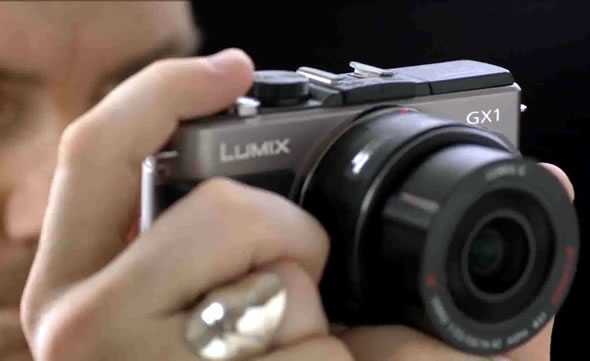
Panasonic has just released a number of teaser videos for its upcoming GF1 successor, the Panasonic Lumix DMC-GX1 Micro Four Thirds digital camera. We first broke the news of the GX1 in October and the company’s, now official promotional video, confirms our initial specifications.
The Panasonic GX1 will have a 16-megapixel sensor, probably the same as the Panasonic G3, and a new Venus engine. It will offer a super fast 0.09 second contrast auto-focus. The main screen is a 3-inch LCD with a 460k pixel resolution, and as we guessed, it will be a touchscreen for touch autofocus, similar to other recent Panasonic offerings.
There will be a new external electronic viewfinder (EVF) with 1,440k dots (against a paltry 202k of the original LVF1) and it will be offered in silver and black. While we weren’t too excited when we first saw the all black boxy design of the GX1, it looks way sexier in the official video with the silver metal body and oversized black handgrip.
In the video, which you’ll find after the break, the GX1 is paired with the new X series lens, the collapsible power zoom LUMIX G X VARIO PZ 14-42mm. There is also another video after the break showing a movie shot using the GX1 with a new miniature / time lapse effect, similar to the Panasonic LX5‘s miniature effect.
continue reading

You can now watch the full 52 minutes and 55 seconds of Samsung’s London event showing off their Super AMOLED HD duo, the Galaxy Note and Galaxy Nexus. The Note was the star of the show, with Samsung representatives going over every detail of the 5.3-inch tablet-phone and embellishing over the S Pen stylus. However the last fifteen minutes were devoted to the upcoming Galaxy Nexus — if you missed it, you can watch the Galaxy Nexus and Android 4.0 event here.
You can find the video after the break. We should let you know that you can get the Galaxy Note right now in Europe (U.S. availability still under speculation), while the Galaxy Nexus will roll-out first in Europe on November 17th and a U.S. release will follow shortly after.
continue reading

The Nokia N9 MeeGo smartphone is an all-screen unibody beauty. Unfortunately, many around the world will never get to see the N9 and its MeeGo OS in person. Following Nokia’s agreement with Microsoft on using Windows Phone on its smartphones, the MeeGo running N9 will not be released in any key markets such as the U.S., Canada, U.K., Germany and Japan.
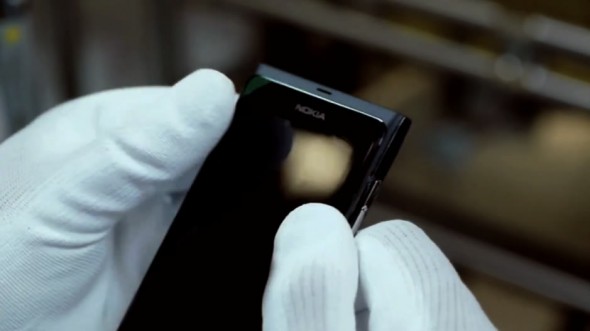
As an ultimate tease to us, Nokia has just released a video showing an N9′s journey through the manufacturing process, from getting its polycarbonate body precisely machined, the 1GHz TI OMAP3630 processor and 1GB of RAM installed on its mainboard, the 8-megapixel camera with Carl Zeiss 28mm wide angle f/2.2 optics fitted and finally the Gorilla Glass 3.9-inch AMOLED touchscreen display attached with love.
The N9 is expected to land in Australia and Latin America shortly. Fortunately, those living in the countries excluded from this release, will be able to put their hands around a pretty identical handset running Windows Phone 7.5 Mango, instead of MeeGo, the rumored Nokia 800 a.k.a. “Sea Ray”.
Oh, yes, the video is after the break, if you are feeling strong enough to resist your urges.
continue reading
- GuidesReviews
- By Alexis Phi

The X100 shoots amazing photos, in general, and some of the best low-light pictures of any compact camera — it looks the part too. You can read our in-depth real world review here. Unfortunately, it’s not a speed demon; specifically, auto focus, startup time and SD card write speeds are relatively slow. This means that it’s not the ideal action shooter.
Nevertheless, there are things that you can do to get the camera to perform faster. The X100 includes a ‘Quick Start Mode’, which Fuji claims to reduce startup time to about 0.7 seconds compared to about 2.2 seconds when the mode is off. This mode is accessible on page 3 in setup. Fuji however, warns that, setting the mode to on will drain your battery, reducing the number of shots per charge.
It’s also been suggested that a fast SD card will help reduce startup times and of course file write times. So, with this suggestion we set out to test the X100′s performance with three different SD cards: a top of the range SanDisk Extreme Pro card claiming 45MB/s write speeds, a SanDisk Extreme III card with 30MB/s write speeds and finally a cheaper Transcend 16GB Class 10 card.
We measured the amount of time between switching the camera on and the camera becoming responsive, i.e. being able to focus, first, with the quick start mode off, and again with the quick start mode on for each of the three SD cards.
Then, we shot eight continuous RAW files, with each of the cards, in burst mode, and measured the time between pressing the shutter button, taking the 8 shots and the camera becoming responsive again, after writing the files to the SD card.
You can see the results, of our lengthy tests, below — note that we examined the video of our tests in slow-motion to assess the time better and avoid reaction time errors:
continue reading

If you missed the Google and Samsung event, when was it streaming live, you can now watch the entire event below. The event covered most of the basics of what’s new in Android 4.0 Ice Cream Sandwich and of course unveiled Samsung’s new flagship smartphone, the Galaxy Nexus.
If you are a fan of little green robots, you will find the video after the break.
continue reading

Panasonic designed the GH2 Micro Four Thirds camera to also shoot great video and the digital camera has received a warm embrace by the amateur video community. Out of the box the GH2 can shoot full HD 1080i video at the maximum AVCHD bitrate of 24 Mbit/s (Mbps).
Leave it to the hacking community to achieve what even Panasonic’s engineers would not have though possible. Not too long ago the GH2 received the hacking treatment with a custom firmware courtesy of user ‘Vitaliy’ which unlocked the GH2 to new possibilities. Well, testers have been pushing the envelope since then and a recent contribution by user ‘Driftwood’ has pushed the GH2 to record video at a whopping 176Mbps in a format titled AVCHD Intra.
What’s incredible is that the GH2 can actually manage such a high bitrate, this is by far the highest for any mirrorless or DSLR camera out there. You can catch two videos recorded at this setting after break, showing off the amazing picture quality.
continue reading

HTC decided to take a more original approach in promoting the EVO 3D in Poland. The smartphone company commissioned a huge ‘promotional’ graffiti on a wall in the capital Warsaw.
Curious onlookers watched as the mural of an EVO 3D with buildings popping out of the screen — to remind us of its 3D abilities — slowly took shape. What can we say, great looking phone, and great looking street art. Definitely a 10 for HTC on creativity.

The video of the full escapade is after the break.
continue reading

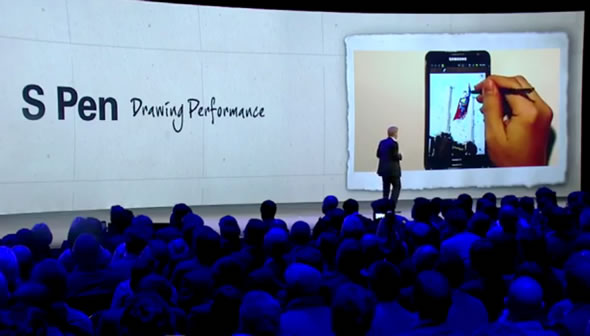
There are two things that make the Samsung Galaxy Note stand out, first is its incredible 5.3-inch HD Super AMOLED screen, and second, the stowable S Pen stylus. The S Pen is a pressure sensitive stylus which paired with a host of Samsung applications allows you to perform certain tasks, such as taking handwritten notes, but also to unleash your creativity by drawing directly on your phone’s screen.
Head over after the break to see a demo video of what someone with artistic inclinations can do on the Note.
continue reading

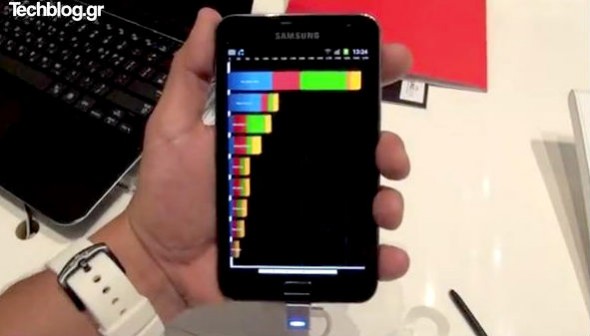
We’ve already expressed our excitement for Samsung’s mammoth new phone, the 5.3-inch HD Super AMOLED Galaxy Note, in our previous coverage. Well the good folks over at Techblog.gr got the chance to run the Quadrant benchmark on the device at the IFA show floor and got some unsurprisingly impressive results.
The Note runs on a dual-core Samsung 1.4GHz processor and managed to score 3,624 on Quadrant, ever so slightly better than even then 1.2GHz Samsung Galaxy S II score, putting it ahead of every other Android smartphone in terms of processing performance.
It’s important to note, however, that the Galaxy Note features a screen resolution of 1280×800 pixels, meaning that it pushes 2.7-times for pixels than the Samsung Galaxy S II (with resolution 800×480). That alone makes the benchmark result even more impressive. You can see the benchmark for yourselves at around the 4.5-minute mark on the video after the break
Of course, performance doesn’t come cheap, the Samsung Galaxy Note is expected to hit Scandinavian shores — Norway, Finland, Sweden and Denmark — first, in November, with a price tag of around 670-750 euros ($1,000). The phone is then expected to arrive in the UK a the start of 2012 but no US availability in the horizon yet.
continue reading

Sony has created a series of mouthwatering videos showing off its entire new line of cameras and lenses. The first video below is dedicated to the Sony Alpha A77 while the second covers the NEX-7, A65, NEX-5N, the new E-mount lenses, Alpha-mount adapter and the NEX-VG20 camcorder.
We’ve particularly noted the mention of the benefits of an OLED viewfinder in terms of refresh rate over LCD. Best moment of both videos is definitely the demonstration of the A77′s 12fps burst shooting. A word of warning, watching any of these videos could significantly hurt your medium-term financial status.
continue reading